
Interviewer Training for Hiring Managers: A Practical Guide
You can know exactly what your business needs and still finish an interview unsure whether the candidate can do the job.
They were friendly. They spoke confidently about their experience. They seemed interested in the role. But when you sit down to make the decision, your notes contain very little about how they actually work.
That uncertainty becomes harder to resolve when several people are involved. One interviewer values confidence. Another looks for detailed examples. Someone else recommends the person they found easiest to talk to. Each person believes they are assessing suitability, but they are applying different standards.
Interviewer training gives your team a shared way to gather evidence and make sense of it. It helps managers ask relevant questions, explore incomplete answers and explain their recommendations against the requirements of the job.
For a small business, a useful starting point is a focused practice session built around an upcoming vacancy. The team prepares the questions, rehearses an interview and compares how they score the same answers. That conversation can reveal weaknesses in the process before those weaknesses affect a real candidate.
What should interviewer training teach?
Interviewer training prepares hiring managers to conduct interviews that produce useful, comparable evidence about candidates.
It should develop four connected skills: deciding what to assess, asking questions that reveal it, recording what the candidate says and judging that evidence against an agreed standard.
Structured interviewing provides a foundation for this work. Candidates receive a common set of questions, and their answers are assessed using consistent criteria. Those questions can explore previous experience or ask how someone would handle a realistic situation. OPM’s structured interview guidance describes both approaches.
The training comes in learning how to use that structure well.
An interviewer needs to recognise when an answer is too general to assess. They need to ask for clarification without supplying the answer themselves. They also need to distinguish evidence of a skill from an impression of the person.
A candidate who speaks confidently may still describe a poor decision. Someone who pauses before answering may provide a thoughtful, relevant example. The interviewer’s task is to establish what the answer demonstrates about the work.
Everyone contributing to the hiring decision should understand that task, including experienced managers. Interviewing regularly does not necessarily mean that colleagues interpret the same answer in the same way.
Begin with the work the person will actually do
The most useful interviewer training starts with a real role.
Choose an upcoming vacancy and identify the tasks the person must handle successfully. Then decide which requirements the interview can reasonably assess.
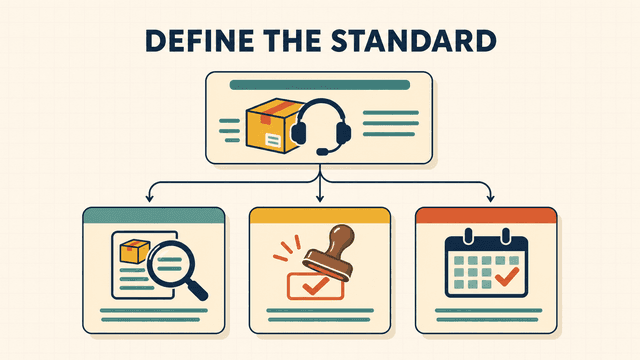
For a customer-service assistant, those requirements might include understanding a customer’s problem, choosing an appropriate response and recognising when a decision needs approval. For an administrator, they might include organising competing requests, checking information and communicating delays.
Be careful with broad descriptions such as “good attitude”, “strong communicator” or “a natural fit”. They leave too much room for personal interpretation.
If communication matters, describe the communication the job requires. Perhaps the employee must explain a delivery delay clearly, check that a customer understands their options or hand over an unresolved issue accurately. Those are behaviours your team can ask about and assess.
Before the training session, prepare a short brief covering:
- The main responsibilities of the role.
- The requirements the interview will assess.
- The core questions candidates will receive.
- What acceptable evidence would look like.
- Any authority limits or procedures candidates need to understand.
This preparation gives the team something concrete to practise.
It also makes an interview scorecard more useful. A scorecard should explain the standard behind the number. If one manager thinks a rating means “confident answer” and another thinks it means “demonstrated the required skill”, the form will preserve their disagreement rather than resolve it.
Agree the criteria before candidates enter the process. Your structured interview plan can then connect those criteria to the questions, interview stages and final discussion.
Practise asking questions that reveal useful detail
A question is only useful if the answer gives you something relevant to assess.
Consider asking a candidate how they have handled an unhappy customer. They reply:
“I always stay positive. I’m good with people, so I usually find a way to help.”
The answer tells you how the candidate describes themselves. It gives you very little about what they did.
An interviewer who moves straight to the next question loses the opportunity to understand the example. An interviewer who starts suggesting solutions risks shaping the response.
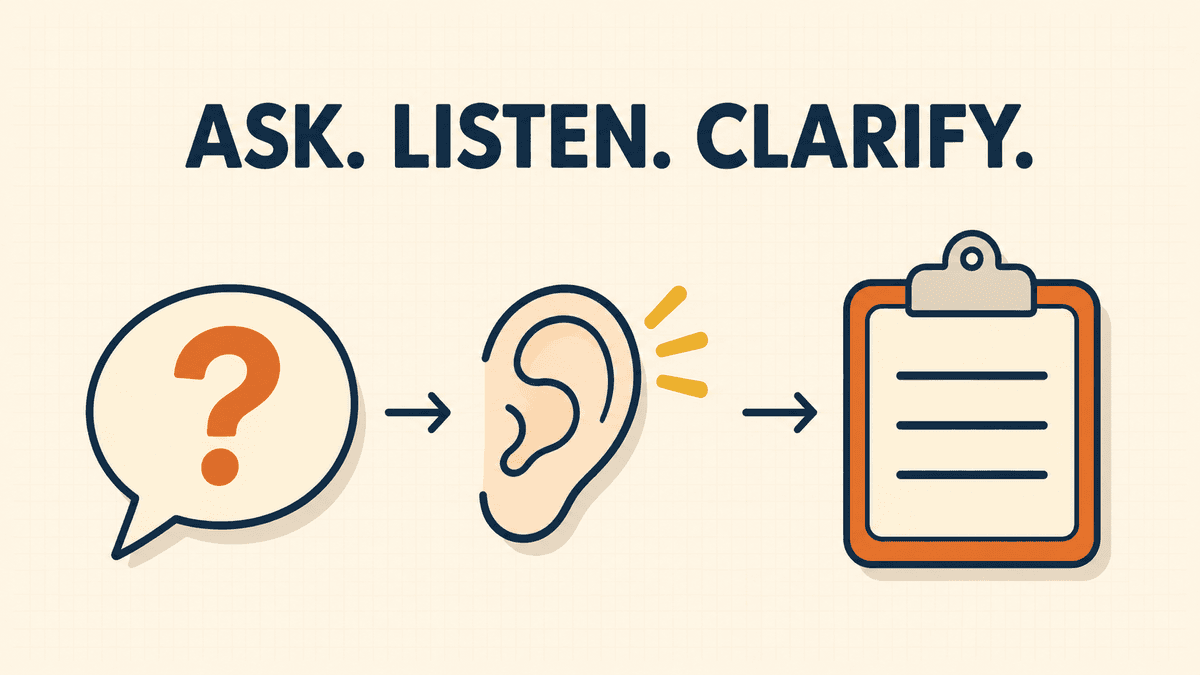
Instead, practise neutral follow-ups:
“Can you talk me through a specific occasion?”
Then:
“What did you do?”
And:
“What happened after that?”
For a hypothetical situation, the follow-up might be:
“What information would you need before deciding?”
These questions invite the candidate to supply the detail.
Compare that with:
“Wouldn’t you check the order and offer a replacement?”
That question reveals the interviewer’s preferred approach. A candidate can agree without showing how they would have reached the decision independently.
Structured interview training should include this distinction. A consistent interview still allows clarification; UK government guidance on structured interviews recognises follow-up questions and the possibility that a good answer may take an unexpected form.
When practising, ask the observer to notice when the interviewer interrupts, changes the subject too quickly or turns a follow-up into a suggestion. These small habits can determine whether the conversation produces enough evidence.
Use a few relevant interview questions and follow-up prompts, then rehearse the listening and follow-up work around them.
Run a practice interview and score the evidence
A rehearsal allows your team to try the process before a hiring decision depends on it.
With three people, assign an interviewer, a practice candidate and an observer. With two, take turns interviewing and review the notes together afterwards.
For a suggested one-hour session, spend ten minutes reviewing the role and criteria, fifteen minutes practising the questions, ten minutes scoring independently, fifteen minutes comparing the evidence and ten minutes repeating the part that needs work.
The purpose is to find out what each interviewer can do and what they need to practise next.
The following fictional exercise gives you a starting point.
The role and question
Imagine you are hiring a customer-service assistant for an online retailer.
Give everyone the same information about the company’s procedure:
- The assistant checks the order record and confirms what arrived before choosing a remedy.
- They may arrange a replacement after confirming the error and checking stock.
- Refunds need a supervisor’s approval.
- They record the agreed action and give the customer a realistic update.
Then ask:
“A customer says they have received the wrong item. Talk me through how you would handle it.”
For this exercise, assess one requirement: choosing an appropriate response within the role’s authority.
The company procedure is supplied because you are assessing how the person uses that information. You are not expecting them to guess an unfamiliar employer’s rules.
Agree the scoring standard
Use this three-point practice scale:
| Score | Standard |
|---|---|
| 1 — Significant concern | The answer proposes a material error, such as issuing a refund without approval or choosing a remedy before verifying the problem. |
| 2 — Partly meets the requirement | The approach is broadly appropriate but contains a clear, consequential gap, such as promising a replacement before checking availability. |
| 3 — Meets the requirement | The answer verifies the issue, follows an appropriate route within the assistant’s authority and provides a workable record and update. |
Keep insufficient evidence separate from these scores. If the answer is too vague to assess, ask a follow-up and record what remains unclear.
Compare three answers
Ask each participant to score these fictional responses independently before discussing them.
Answer one
“I’d check the order and confirm we’d sent the wrong item. Then I’d refund the customer straight away so they weren’t left waiting. I’d add a note to the account and tell my supervisor afterwards.”
This receives 1 under the practice scale. The candidate proposes issuing a refund before obtaining the required approval.
The useful evidence note is specific: “Would refund before supervisor approval.” A description such as “seems impulsive” adds an interpretation about the person without improving the assessment.
Answer two
“I’d check what they ordered and what arrived. I’d promise to send a replacement that afternoon, then check stock and arrange it. If we didn’t have one, I’d call them back. A refund would need my supervisor’s approval.”
This receives 2. The candidate checks the problem and respects the refund approval limit, but makes a dispatch promise before establishing whether it can be fulfilled.
The concern comes from an action the candidate describes. It is stronger evidence than assuming that an unmentioned step would never happen.
Answer three
“I’d check the order and what arrived, then discuss the resolution they wanted. For a replacement, I’d check stock before agreeing the dispatch timing. If they wanted a refund, I’d seek approval. I’d record the agreed action and explain when they should expect an update.”
This receives 3. The response meets the stated requirement: verify the issue, choose an appropriate route, respect authority limits and communicate the next step.
It earns that score without requiring the candidate to redesign the complaints process or demonstrate responsibilities beyond the job.
Other answers could also meet the standard. These examples illustrate how to connect evidence to a rating; they are not scripts that candidates must reproduce.
Practise recognising missing evidence
Now consider:
“I’d do whatever I could to make the customer happy.”
There is not enough detail to apply the scale. Ask:
“Talk me through the steps you would take.”
If the answer remains general, record insufficient evidence.
That distinction matters. An answer that explicitly proposes an unauthorised refund demonstrates a concern. An answer that does not explain the proposed action leaves a question unresolved.
The exercise assesses proposed behaviour in a fictional situation. Adapt its policies and criteria to the actual role before using a similar question in recruitment.
Teach the team how to discuss different scores

After the exercise, the most useful conversation begins with the evidence.
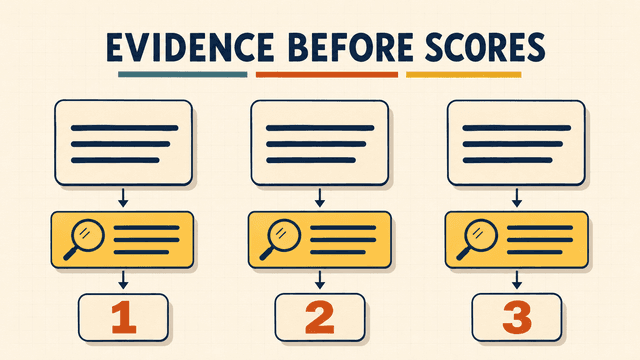
Ask each interviewer to explain what the candidate said, what that establishes about the requirement and why it meets a particular rating.
Complete individual ratings before the discussion. CIPD’s selection guidance recommends this sequence to limit the influence of other interviewers, including senior colleagues.
This process is often called interview calibration: checking how consistently people apply the same criteria.
Suppose one manager gives the second sample answer a 3 because the candidate sounds helpful. Another gives it a 2 because of the dispatch promise.
Return to the agreed requirement. The issue is whether the proposed response follows the procedure reliably. A helpful intention does not resolve the unverified commitment.
Disagreement can reveal several things. Someone may have missed a detail. The question may be unclear. The scoring definitions may overlap. Resolve the underlying issue instead of averaging the numbers simply to finish the discussion.
Feedback to the interviewer should be equally specific.
“You need to listen better” gives someone little to practise. A more useful observation is:
“You moved to the next question before the candidate explained their decision. On the second attempt, pause and ask what led them to choose that action.”
Then repeat that part of the interview.
The same discipline improves written interview feedback. Notes should help another person understand the recommendation through relevant evidence.
Carry the training into real interviews
A successful practice session should change what interviewers do.
Before someone interviews independently, check whether they can explain the process, ask the agreed questions, explore relevant gaps, record useful notes and justify a score. Where a skill needs more work, arrange another rehearsal or pair them with an experienced interviewer.
Include the candidate’s experience in that preparation. Interviewers should be ready to answer reasonable questions about the role, handle interruptions and explain what happens next.
For UK employers, Acas guidance on interviewing applicants recommends preparing interviewers, planning for technical problems in online interviews and explaining decision and follow-up arrangements.
Also examine how personal impressions enter the assessment. A familiar career path, shared interest or confident manner can attract attention without establishing suitability. Ask interviewers to explain their recommendation through the requirements agreed for the role. The guide to fair hiring practices for small businesses develops this approach further.
After the next interview round, review whether the process produced the information you needed. Were notes detailed enough to support the ratings? Which questions repeatedly required clarification? Where did interviewers interpret the criteria differently?
Use those findings to choose the next training activity. A team struggling with follow-ups needs different practice from a team collecting good evidence but applying unclear scoring standards.
External training can help when the team needs specialist guidance or repeated practice has not resolved the problem. Look for a course that includes observed interviewing, scoring exercises, specific feedback and another attempt. Ask what participants must demonstrate to complete it.
Keep the same discipline when using HireMike
HireMike supports the early stages of hiring through CV assessment and structured AI first-round interviews. You define the role requirements and approve the criteria and questions, then review the assessments, transcripts and recordings to decide who progresses. See how HireMike works.
Your team still needs to understand what the evidence establishes and where further assessment is needed. Interviewer training strengthens that review as well as the conversations you conduct yourselves.
Before your next hire, choose one question and practise it together. Agree what it assesses, score the same answers independently and discuss the reasons for any differences. Then repeat the part that was difficult, so the team enters the next interview better prepared.